Custom Handwired Rust-BLE Keyboard
A fully custom, 3D-printed, Bluetooth split mechanical keyboard built without a PCB, running Rust firmware on nRF52840 microcontrollers.
Author: Constantin Eduard-Andrei
GitHub Project Link: https://github.com/UPB-PMRust-Students/fils-project-2026-Edward-game-scr
Description
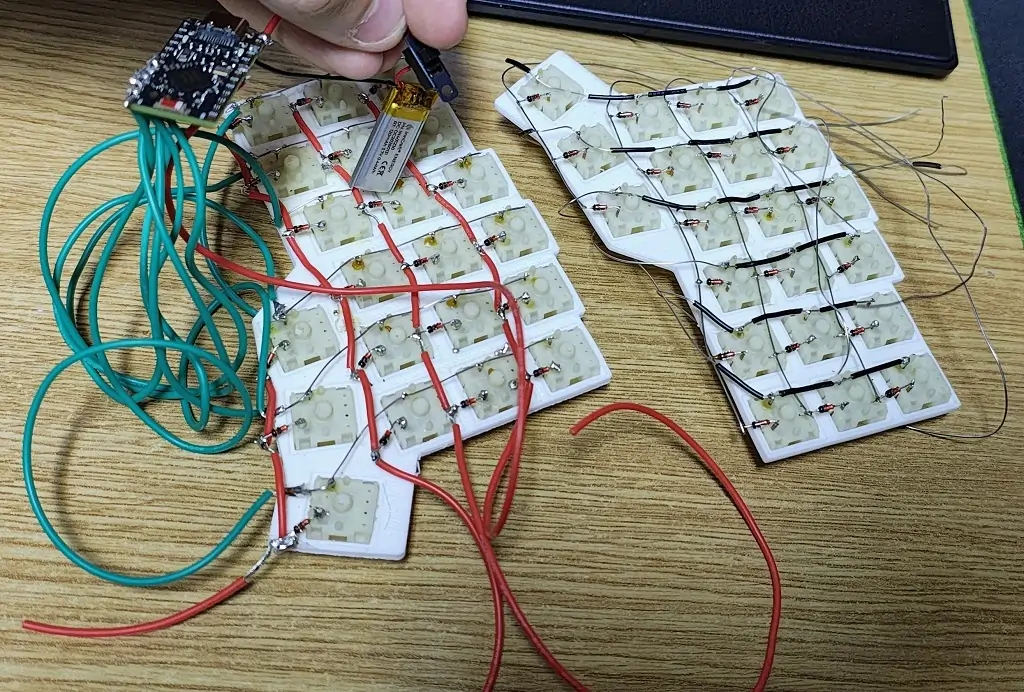
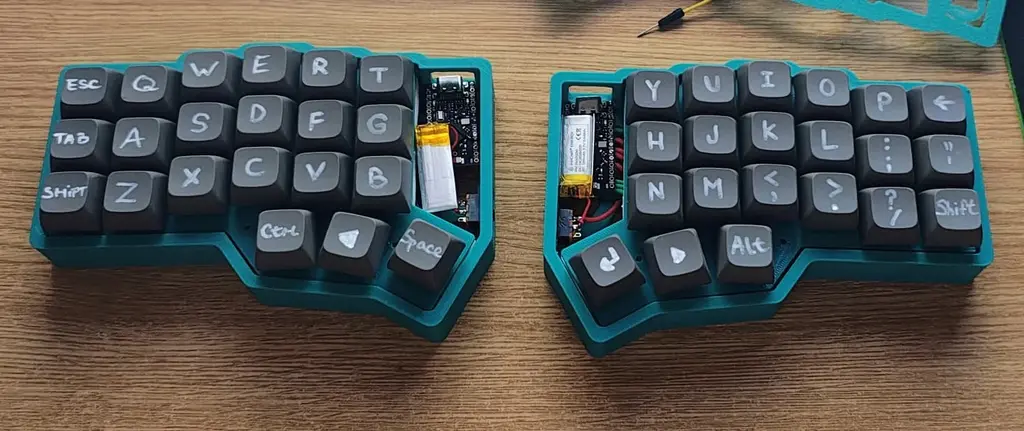
This project is a custom-built, wireless split mechanical keyboard based on the ergonomic Corne layout (4 rows × 6 columns per half, plus a 3-key thumb row on each side). There is no PCB: every switch is handwired into a diode matrix and mounted in a 3D-printed plate!
Each half uses a SuperMini nRF52840 (Adafruit nRF52 Bootloader, UF2 drag-and-drop flashing). The firmware is written in Rust and built on the RMK 0.8 framework with a dual-binary BLE split architecture: the left half acts as the central (USB/BLE to the PC, full keymap), and the right half acts as the peripheral (scans its matrix and sends coordinates over Bluetooth). Configuration lives in keyboard.toml (pins, matrix map, three layers).
The original plan was to implement matrix scanning, debouncing, and a BLE HID keyboard stack manually with embassy-rs and Nordic’s softdevice bindings. After roughly a week of attempts where the nRF52840 radio/HID path never came together reliably, the project moved to RMK, which still uses Embassy and modern Rust async patterns under the hood but provides a proven split-BLE and keymap pipeline.
Motivation
I chose this project to get real experience on both sides of a custom keyboard: bare-metal wiring and modern embedded Rust.
On the hardware side, handwiring forces you to understand rows, columns, diodes, ghosting, and how few GPIO pins can serve many keys. On the software side, I wanted to learn how a keyboard actually becomes a BLE HID device not just flash someone else’s binary.
A practical goal too: a compact wireless keyboard for the TV/PC so searching and typing away from the desk is faster than a remote.
Architecture
Hardware
- Layout: Split Corne — 21 keys per half (18 in the main 3×6 grid + 3 thumb keys).
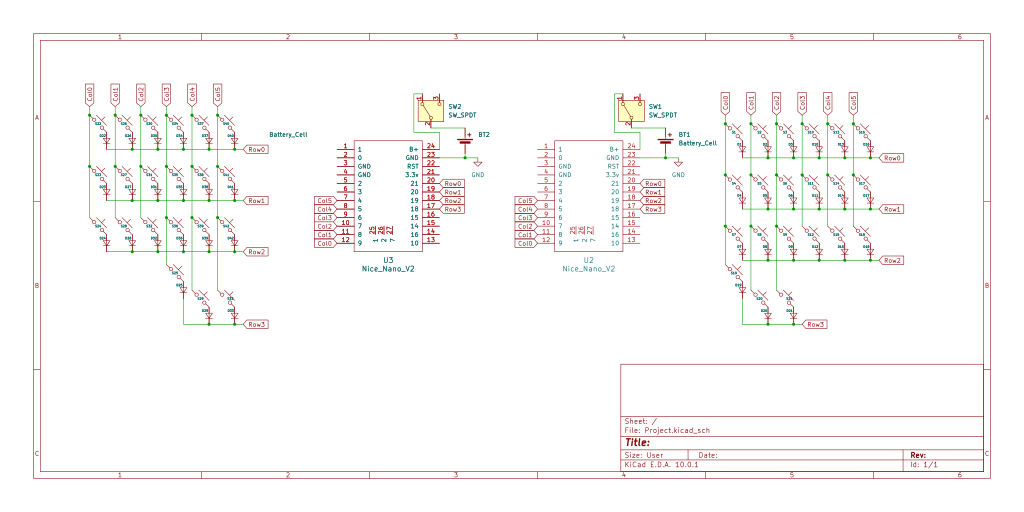
- Matrix: 4×6 per half; 1N4148 diodes (column → row) to prevent ghosting.
- Controllers: Two SuperMini nRF52840 boards (nice!nano v2–class clones).
- Power: 3.7 V LiPo per half with a slide power switch.
- Structure: 3D-printed switch plate and case; 24 AWG solid wire for row/column buses.
Firmware (final)
| Role | Binary | UF2 output | Responsibility |
|---|---|---|---|
| Left half | central | NEW_LEFT.uf2 | BLE central, matrix scan (cols 0–5), USB/BLE HID to host, full keymap |
| Right half | peripheral | peripheral.uf2 | BLE peripheral, matrix scan (cols 6–11 via col_offset = 6), sends (row, col) to central |
Pin map (both halves, local wiring) — inner column toward the split, outer toward the pinky:
| Row | MCU pin |
|---|---|
| Row 1 (top) | P0_31 |
| Row 2 | P0_29 |
| Row 3 | P0_02 |
| Row 4 (thumb) | P1_15 |
| Col | MCU pin |
|---|---|
| Col 1 (inner) | P1_06 |
| Col 2 | P1_04 |
| Col 3 | P0_11 |
| Col 4 | P1_00 |
| Col 5 | P0_24 |
| Col 6 (outer) | P0_22 |
Keymap (3 layers) — defined in keyboard.toml:
- Layer 0: QWERTY Corne base; left thumb
MO(1)(symbols), right thumbMO(2)(nav/F-keys/BT). - Layer 1: Numbers and symbols (
\~!…[]{}, etc.). - Layer 2: F-keys, arrows, paging, BLE profile/clear (
User1/User2/User5), and modifier combos (WM(...)) for shortcuts.
Build & flash
cargo build --release --bin central    →  NEW_LEFT.uf2   (left only)
cargo build --release --bin peripheral →  peripheral.uf2 (right only)
cargo make uf2                         →  both UF2 files
Family ID for UF2: 0xada52840 (Adafruit nRF52). Flash memory layout reserves the bootloader region (FLASH from 0x1000).
Software path (what actually happened)
- Week ~1 (failed path): Custom
embassy-nrf+ softdevice/BLE HID experiments—matrix ideas worked in isolation, but getting a stable BLE keyboard device on the nRF52840 did not, despite many rebuild/flash cycles. - Final path: RMK 0.8.2 with
rmk_central/rmk_peripheralmacros,keyboard.toml, and Vial-compatible storage. Minimal application code (central.rs,peripheral.rs); complexity moved into configuration and build tooling.
Log
5–8 May
Finalized the Corne layout choice and BOM. Ordered SuperMini nRF52840 boards, Gateron Milky Yellow switches, 1N4148 diodes, LiPo cells, wire, keycaps, and power switches. Started the 3D model/plate while waiting on shipping.
9–11 May
Parts still in transit. Read nRF52840 docs, Embassy book chapters, and split-keyboard matrix guides. Sketched row/column routing on paper so the handwire would not be guesswork later.
12–15 May
Printed the switch plate and case pieces. Began the left half handwire: diode orientation (column → row), column buses along the inner edge, first row soldered. Multimeter continuity checks after every few keys—caught one reversed diode early.
16–18 May
Finished the left matrix and installed the LiPo + slide switch. Smoke test: power only, then tweezers on row/column pins. Connected one row and one column to the SuperMini to confirm a single intersection could be detected. Right half not started yet—wanted one working grid first.
19–21 May
Completed right half wiring using the same pinout as the left (per-half local row/col numbering). Set up the Rust toolchain (Windows + WSL), thumbv7em-none-eabihf target, flip-link, and cargo-binutils. First flashes used a single-binary approach; behavior was inconsistent on the split.
22–24 May
Hardest software stretch: tried to implement the keyboard without RMK—Embassy executor, GPIO matrix scan, debouncing, and BLE HID using Nordic stack crates (nrf-softdevice / related paths). Spent about a week here: device would compile and flash, but BLE advertising/HID reports never behaved like a real keyboard on the host. nRF52840 + softdevice + HID from scratch was a wall; pivoted to RMK as a maintained framework that already solves split BLE and keymaps.
25–27 May
Regenerated the project around RMK 0.8 dual binaries (central / peripheral). Configured keyboard.toml (matrix pins, matrix_map, BLE addresses). Left controller refused to take new firmware for a while (old image kept running); later fixed with proper UF2 flash and clear_storage. Right half flashed as peripheral.uf2 and paired over BLE. Hit Windows path length limits during builds moved/cloned the repo to a shorter path.
28 May
Left matrix still typed garbage: all keys repeating one character, then a scrambled QWERTY-like grid. Root causes: (1) stale keymap in flash (RMK Vial storage overriding keyboard.toml), (2) wiring not matching the assumed column order. Rewired to the documented pin table; clear_storage = true once to prove keyboard.toml was live (Esc / Q test grid). Confirmed Corne Split BLE name and stable per-key output.
29 May
Removed clear_storage (kept clear_layout while iterating). Implemented full 3-layer Corne keymap (base, symbols MO(1), nav/F-keys/BT MO(2)). Rebuilt NEW_LEFT.uf2; left + right halves work together over BLE. Project functionally complete.
Hardware
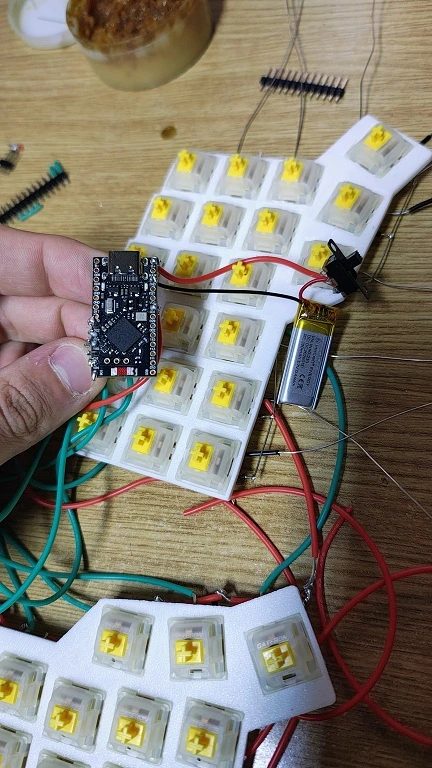
The hardware relies on a 3D-printed chassis to hold the switches, eliminating the need for a PCB. Logic is handled by nRF52840 SuperMini boards for low power and BLE.
Schematics
Bill of Materials
| Device | Usage | Price |
|---|---|---|
| SuperMini NRF52840 | Microcontroller (one per half) | 45 RON |
| Liter Energy 120mAh 3.7V LiPo (401230) | Power supply (per half) | 100 RON |
| Gateron Milky Yellow Pro | Linear switches | 125 RON |
| 1N4148 diodes | Anti-ghosting in the matrix | 16 RON |
| 24AWG solid core wire | Row/column harness | 24 RON |
| PBT XDA 1U keycaps | Keycaps | 58 RON |
| SS12F15 slide switches | Battery power switch | 36 RON |
Software
Libraries used (final firmware)
| Library | Description | Usage |
|---|---|---|
| RMK 0.8 | Rust keyboard firmware framework | Split BLE, keymap, debounce, HID to host; rmk_central / rmk_peripheral |
| embassy-rs | Async embedded runtime | Used internally by RMK (GPIO, timers, USB) |
| embassy-nrf | nRF52840 HAL | Pin/matrix drivers for SuperMini |
| nrf-sdc | SoftDevice Controller (Rust) | BLE stack integration for nRF52840 |
| defmt | Embedded logging | Debug over RTT during development |
Attempted stack (not used in final build)
| Library | Why it was tried |
|---|---|
| nrf-softdevice (Embassy) | Direct BLE peripheral + HID from scratch |
| Custom HID report code | Pair with hand-rolled matrix scanner |
After ~one week without a reliable BLE keyboard on hardware, these were abandoned in favor of RMK’s proven split and Vial/storage support.
Repository layout (firmware)
| File | Purpose |
|---|---|
keyboard.toml | Pins, split BLE addresses, matrix map, layers |
src/central.rs | Left half — BLE central entry point |
src/peripheral.rs | Right half — BLE peripheral entry point |
Makefile.toml | cargo make uf2 — builds both .uf2 images |
memory.x | Linker layout for Adafruit bootloader |
vial.json | Vial GUI matrix definition (optional tuning) |
Links
- RMK documentation
- Embassy book
- Rust Embedded Book
- nRF52840 product specification
- Corne layout reference — physical key arrangement inspiration
- Adafruit nRF52 Bootloader — UF2 flashing on SuperMini
Status
Complete. Both halves type over BLE with a three-layer Corne keymap. Future tweaks are keyboard.toml edits + reflash NEW_LEFT.uf2 on the central only; the peripheral only needs a reflash if matrix pins or BLE pairing metadata change.