Smart Parking System
A smart parking system with real-time spot monitoring and web-based reservation.
Author: Dragomirescu Alexandru
GitHub Project Link: https://github.com/UPB-PMRust-Students/fils-project-2026-alexdragomirescu06
Description
The Smart Parking System monitors parking spots in real time using ultrasonic sensors. A servo motor controls a barrier that opens automatically when there are open spots in the parking lot, or when a valid PIN is entered via a keypad in the case of a reserved spot. A display shows the current status of the parking lot and prompts you to enter the reservation code via a keypad, and a web interface hosted on the Raspberry Pi Pico W allows users to reserve spots remotely over WiFi.
Motivation
I chose this project because it combines multiple hardware components and communication protocols into a single practical system. It covers areas like sensor reading, motor control, display output, network communication, and user input — making it a comprehensive project that reflects everything learned throughout the semester.
Architecture

The system is built around the Raspberry Pi Pico W as the central controller, running software written in Rust using the embassy-rp async framework.
Main components:
- Raspberry Pi Pico 2 W — main microcontroller, handles all logic and WiFi
- Ultrasonic Sensors (HC-SR04 x6) — detect whether each parking spot is occupied
- Servo Motor (SG90) — controls the entry/exit barrier
- ST7735 TFT Display (1.8" 128x160) — shows parking spot availability and system status
- 3x4 Keypad — allows users to enter a PIN to open the barrier
- Status LEDs (x6) — one per spot, give instant visual feedback on occupancy
- Web Interface — hosted on the Pico 2 W, accessible over WiFi for remote reservation
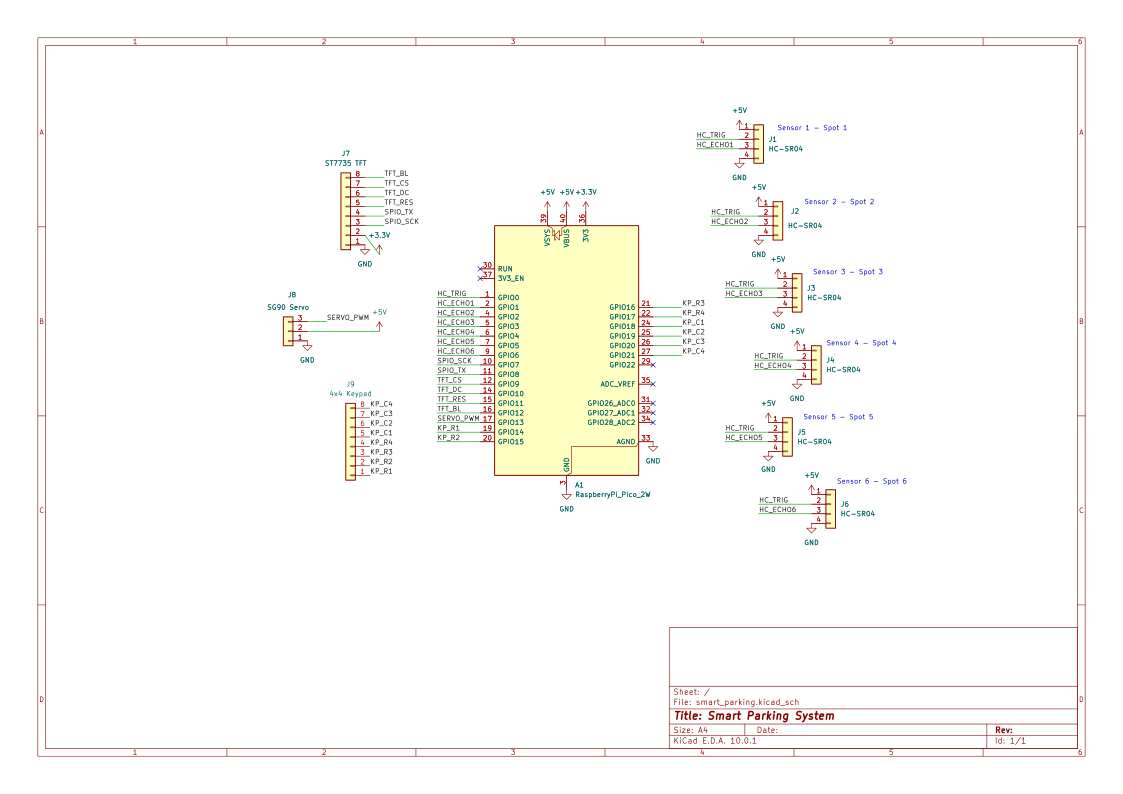
All components communicate with the Pico 2 W directly: ultrasonic sensors via GPIO, servo via PWM, TFT display via SPI, keypad via GPIO matrix scanning, LEDs via GPIO, and the web interface via the onboard WiFi stack.
Log
Week 4-5
After going through multiple possible projects, finally landed on the basic idea of a smart parking system and started researching exactly what hardware components would be needed.
Week 5-6
Expanded on the original idea by adding the web interface for online reservations.
Week 7-8
Ordered all necessary components, currently waiting on their delivery.
Hardware
The hardware is based on the Raspberry Pi Pico 2 W microcontroller. Six HC-SR04 ultrasonic sensors detect the presence of a vehicle in each parking spot. An SG90 servo motor acts as a barrier gate. An ST7735 1.8" TFT display shows real-time status over SPI. A 3x4 matrix keypad is used for PIN input, and six status LEDs provide instant visual feedback on spot occupancy.
Schematics
Bill of Materials
| Device | Usage | Price |
|---|---|---|
| Raspberry Pi Pico 2 W | The microcontroller | 52.18 RON |
| HC-SR04 Ultrasonic Sensor | Parking spot detection (x6) | 12.80 RON each |
| SG90 Servo Motor | Barrier control | 15.29 RON |
| ST7735 TFT 1.8" 128x160 SPI Display | Status display | 53.48 RON |
| 3x4 Matrix Keypad | PIN input | 8.91 RON |
| Breadboard 830 points (x3) | Prototyping | 12.42 RON each |
| LED Kit 3mm 100pcs | Status indicators | 10.53 RON |
| Male-Male Jumper Wires 20cm (x40) | Connections | 17.93 RON |
| Jumper Wires | Connections | 16.15 RON |
| 330Ω Resistors Kit (200pcs) | Current limiting for LEDs | 32.41 RON |
Software
| Library | Description | Usage |
|---|---|---|
| embassy-rp | Async embedded framework for RP2040 | Main async runtime and peripheral drivers |
| embassy-net | Networking stack for embassy | WiFi and TCP/IP for the web interface |
| st7735s | TFT display driver | Driving the ST7735 display over SPI |
| embedded-graphics | 2D graphics library | Drawing text and shapes to the display |
| heapless | Static data structures | Used for fixed-size buffers without heap allocation |