Stream Deck and Fun
A hybrid USB HID controller and standalone reflex game for streamers and gamers.
Author: Anghelina Stefan-Emilian
GitHub Project Link: https://github.com/UPB-PMRust-Students/acs-project-2026-Atackator
Description
Stream Deck and Fun is a dual-mode hardware peripheral designed to enhance the streaming and gaming experience. The device operates in two distinct modes, toggleable via a physical switch:
- Stream Deck Mode (Control): Acts as a customizable HID interface that sends macro commands to the PC. It features a bi-directional data flow, receiving real-time system feedback such as audio levels, microphone mute status, or live stream alerts.
- "Loading Screen" Mode (Physical Game): A standalone reflex-based game ("Whack-a-Button") that runs 100% on the local hardware. It is designed to keep the user engaged during long matchmaking queues or lobby wait times without needing to alt-tab from the game.
Motivation
I chose this project to explore the idea of building an embedded project that could also be linked to areas that i have an interest in like streaming.
Architecture

Main components:
Microcontroller (STM32 Nucleo): The central processor running Rust Embassy to manage asynchronous tasks, power distribution, and real-time logic routing.
Inputs (Tactile Buttons & Mini Switch): Physical triggers for stream macros and game actions, including a toggle to switch between operating modes.
Low-Level Drivers (GPIO, SPI, I2C): The hardware abstraction layer that handles EXTI interrupts, software debouncing, and precise digital communication protocols.
Visual Outputs (OLED & LED Matrix): A 1.3" screen and 8x8 matrix that display stream alerts, game targets, and live player scores.
Feedback Actuators (LEDs & Buzzer): Provides immediate visual and auditory cues for game hits, alerts, and system status.
Log
Week 5 - 11 May
Week 12 - 18 May
Week 19 - 25 May
Hardware
The project utilizes the STM32 Nucleo-U545RE-Q, a powerful ARM Cortex-M33 microcontroller. This board was chosen for its native USB support and advanced hardware timers, which are essential for driving addressable LEDs and handling HID reports efficiently.
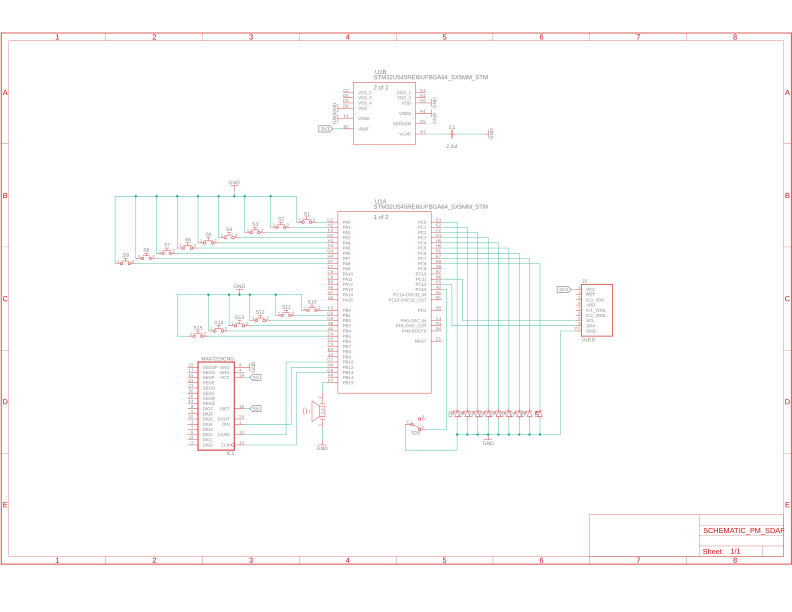
Schematics
Bill of Materials
| Device | Usage | Price |
|---|---|---|
| STM32 Nucleo-U545RE-Q | Main Microcontroller (Cortex-M33) | ~165 RON |
| Display OLED 1.3" Alb 128x64 | Dashboard and Score Display | 36 RON |
| Modul matrice led 8x8, MAX7219, 5V | Volume Visualizer and Status LED | 12 RON |
| Tactile Buttons 12x12mm | Inputs for Deck and Game (15 pcs) | 15 RON |
| Buzzer activ 5v | Audio feedback for game events | 2 RON |
| LEDS | LED (9>) | ~10 RON |
| Passive Components Set | Resistors, Capacitors, Cables, Breadboards | ~35 RON |
Software
The firmware is developed in Rust using the Embassy framework for modern, asynchronous embedded development.
| Library | Description | Usage |
|---|---|---|
| embassy-stm32 | Async HAL for STM32 | Low-level peripheral control and task scheduling |
| usbd-hid | USB HID class device | Emulating keyboard/media keys for PC control |
| embedded-graphics | 2D graphics library | Drawing the UI, icons, and text for the OLED |
| ssd1306 | I2C display driver | Interfacing with the OLED panel |
| smart-leds | WS2812B driver | Managing RGB animations and visualizer colors |