Digital Synthesizer
Polyphonic synthesizer with DSP effects.
Author: Cărpinișan George
GitHub Project Link: https://github.com/UPB-PMRust-Students/acs-project-2026-george17c
Description
A bare-metal polyphonic synth built with Rust. This project is a 48kHz multi-effect audio engine running on an STM32 NUCLEO-U545RE-Q. It features high-level DSP and a hardware interface for instant feedback. It uses a custom-designed top panel interface to hold the controls for a real-time I2S digital audio stream.
Motivation
I like music and I'm fascinated by the hardware behind it. My goal is to recreate a studio-grade musical instrument, to the best of my ability. My synth will have some iconic effects and functionalities from a modern synthesizer for a fraction of its price.
Architecture

The system is designed around a non-blocking, async pipeline:
- Clock Generation: Used a hardware clock to guarantee a 48 kHz audio sample rate, alongside an 80 MHz CPU clock for DSP overhead.
- User Interface (EXTI/GPIO/SPI): Handles asynchronous hardware interrupts from physical components to trigger notes and modify effect parameters. Presets and effects are displayed on an LCD screen.
- DSP Engine: Computes multiple oscillators and applies effects in real-time.
- DMA Controller: Moves audio blocks from RAM to the audio peripheral without interrupting the CPU.
- SAI/I2S Peripheral: Formats the raw data stream into standard I2S frames and sends them to the external DAC.
Log
Week 13 - 19 April
- Wrote the initial DSP logic (oscillators, phase modulation, filtering) in a high-level environment (rodio).
- Started researching components and different top-panel layouts.
- Ordered the first batch of components.
Week 20 - 26 April
- Started the mechanical assembly.
- Configured hardware clocks and initialized the I2S communication with the DAC. Tested its output (a C note from a pulse wave) on my headphones and speaker. Works!
Week 27 April - 3 May
- Finished designing the top panel in AutoCAD.
- Started working on the screen interface for preset selection and effect visualization.
Week 4 - 10 May
- Received the panel.
- Soldered jumper wires on the switches (GPIO pin) and daisy chained their GND pins.
- Soldered wires on the potentiometers.
- Fixed the DAC clock speed, the square wave sounded correctly by chance (it's more tolerant than a sine wave which needs to be sampled more accurately).
Week 11 - 17 May
- Polished the preset logic, made the effect parameters more robust. Only changing their value when a corresponding potentiometer is close to the previous stored value.
- Resoldered some GND pins on the keyboard.
Week 18 - 24 May
- Assembled all the components using a breadboard as a VCC and GND bus. Found out the potentiometers are not properly powered using the breadboard.
- Finished soldering on the proto board.
Hardware
- STM32 NUCLEO-U545RE-Q: processing unit.
- Mechanical keyboard switches, 10k potentiometers, EC11 rotary encoder: to shape the sound.
- 2.8" LCD display: interface for visualizing effects.
- PCM5102 DAC module: for output.
- Power bank: main power supply.
- Wooden box + laser-cut panel.
Schematics
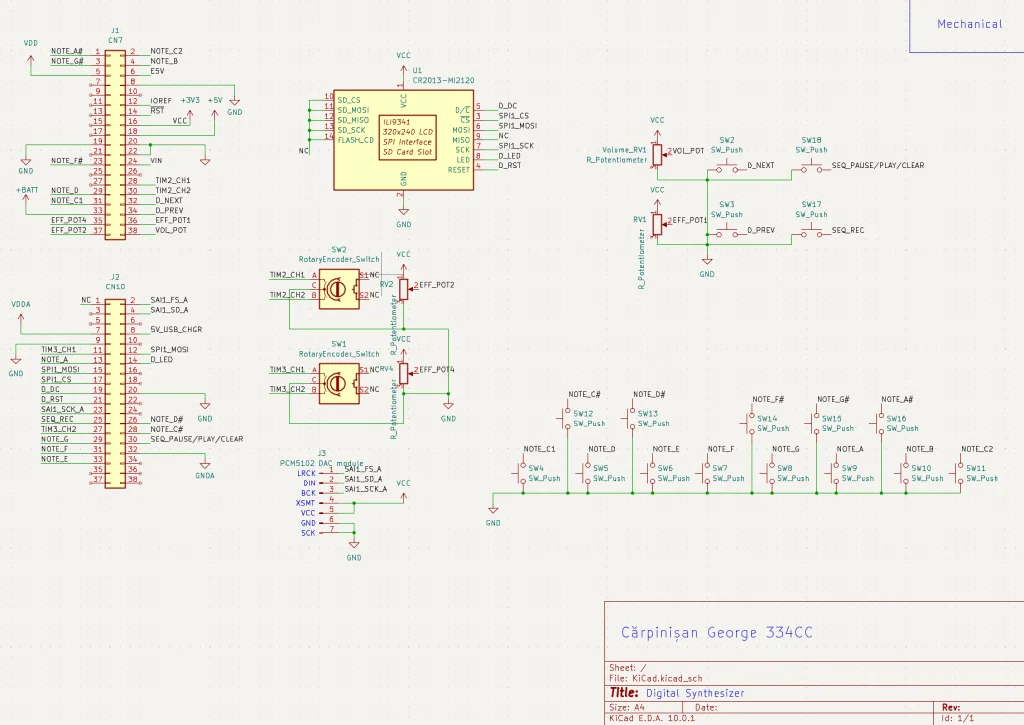
Bill of Materials
| Device | Usage | Price |
|---|---|---|
| STM32 NUCLEO-U545RE-Q | Microcontroller | ~115 RON |
| Keyboard Switches | For triggering notes, navigating the display and using the sequencer | 20 x 0.9 RON |
| 10k potentiometers | For changing effect parameters | 8 x 1.31 RON |
| Rotary Encoder | For navigating the display | 2 x 4.39 RON |
| 2.8" LCD display | For visualizing presets and effects | 55.08 RON |
| Electronics kit | For wires, breadboard | 39.21 RON |
| PCM5102 DAC module | For audio output | 37.50 RON |
| 10 cm female-female wires | To solder on switches | 1 x 6.99 RON |
| 10 cm female-male wires | For the VCC and GND pins of the DAC and display | 2 x 3.99 RON |
| Proto boards | To act as a VCC and GND bus | 2 x 1.28 RON |
| Wooden box | Case for the whole circuitry | 34 RON |
| Laser-cut top panel | For the user controlled knobs and switches | 0 RON |
Software
| Library | Description | Usage |
|---|---|---|
| embassy-stm32 | Async HAL for STM32 | Main hardware abstraction for GPIO, SAI, DMA, SPI, and Clocks. |
| mipidsi | Multi-display driver | Modern driver for the ILI9341 display, compatible with embedded-graphics. |
| display-interface-spi | Generic SPI display interface | Provides the communication layer between the SPI peripheral and the display driver. |
| embedded-graphics | 2D graphics library | Core library for drawing shapes, images, and basic text on the display. |
| micromath | Embedded math library | Provides optimized trigonometric and math functions (sin, cos, exp) for the DSP engine. |
| static_cell | Statically allocated memory | Allows safe runtime initialization of values with a 'static lifetime, for sharing resources with async tasks without a heap memory manager. |
| heapless | Fixed-capacity data structures | Provides structures String, or RingBuffer with static capacities, preventing runtime allocation panics while handling UI state buffers. |
| defmt | Efficient logging | Used for debugging |