Laser Harp
A laser-based musical instrument that converts interrupted light beams into sound in real time.
Author: Beatrice-Elena Sălăvăstru
GitHub Project Link: link_to_github
Description
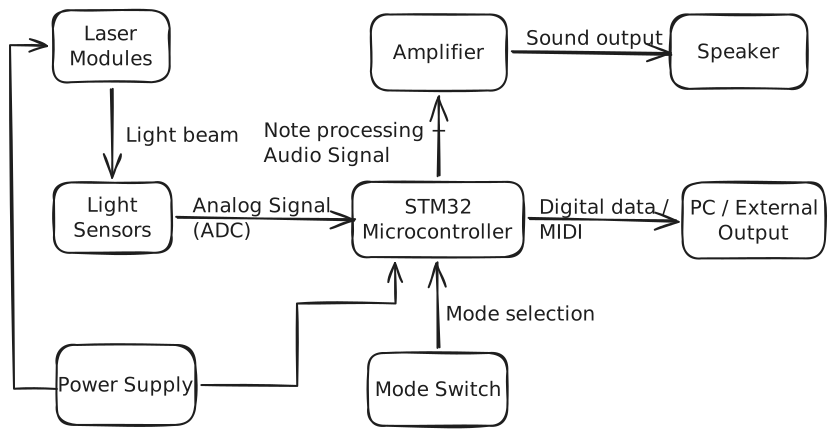
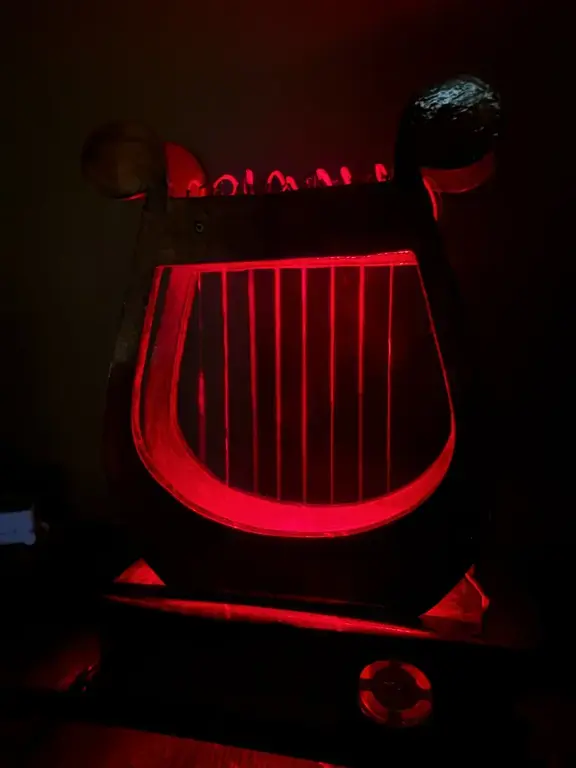
A laser harp system with 8 laser beams acting as strings. Each beam is aligned with a phototransistor. When the user interrupts one of the beams, the STM32 detects the event and plays the corresponding note through a speaker.
Motivation
As someone interested in both music and technology, I want to build an interactive system that translates physical gestures into sound. This project allows me to explore working with optical sensors, handling real-time input from multiple sources, and generating audio signals on a microcontroller. It also gives me the opportunity to integrate hardware and software into a complete system, while creating a visually engaging and intuitive user experience.
Demo
Architecture
Log
Week 5 - 11 April
Designed and built the wooden frame for the laser harp. Planned the layout of laser beams and sensors to ensure proper alignment and stability.
Week 12 - 18 April
Ordered all hardware components from TME and Sigmanortec.
Week 4 - 10 May
Built and tested the electronic circuit using a simple test program. The goal of this stage was to verify that the laser modules, phototransistors, STM32 inputs and audio amplifier worked correctly before integrating the final software.
Week 11 - 17 May
Implemented the sample-based audio playback system. The project was changed from simple frequency generation to playback of RAW audio samples stored directly in the STM32 Flash memory. The system now works as a standalone instrument: the audio is played directly through the speaker, without depending on a USB connection to the laptop for sound generation.
Hardware
The project is built around the STM32 Nucleo-U545RE-Q, which reads the sensors and controls the audio output.
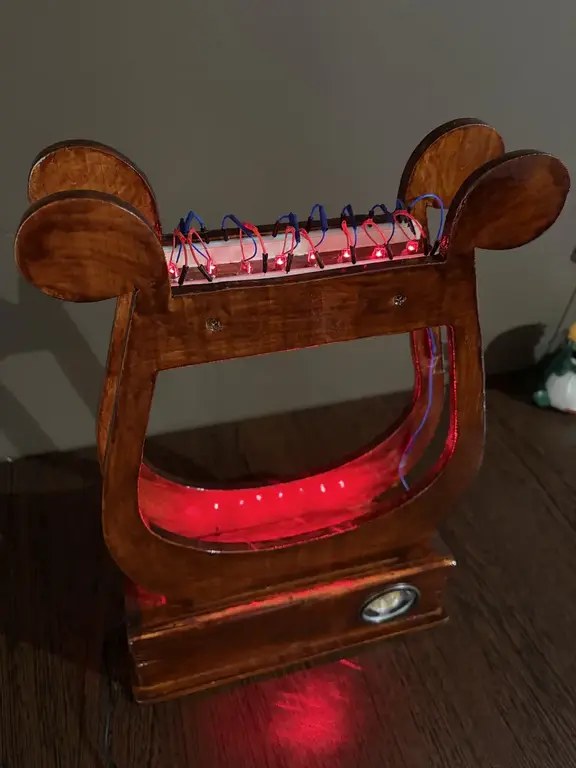
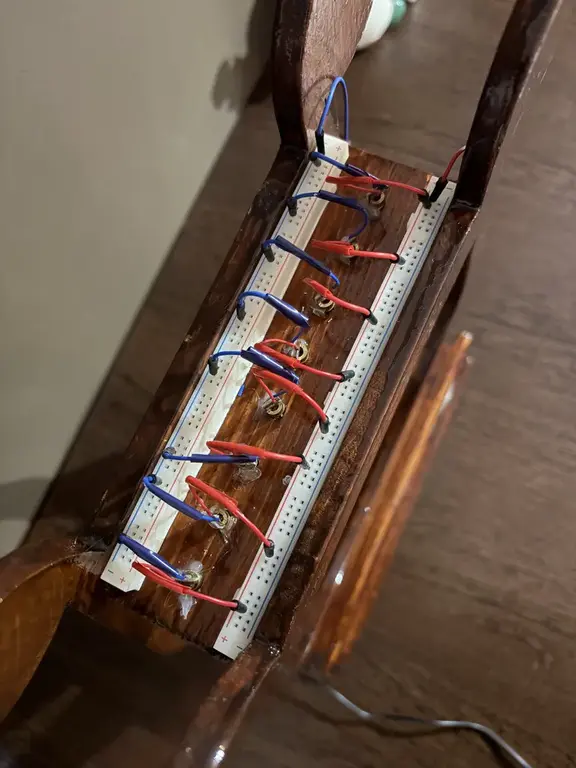
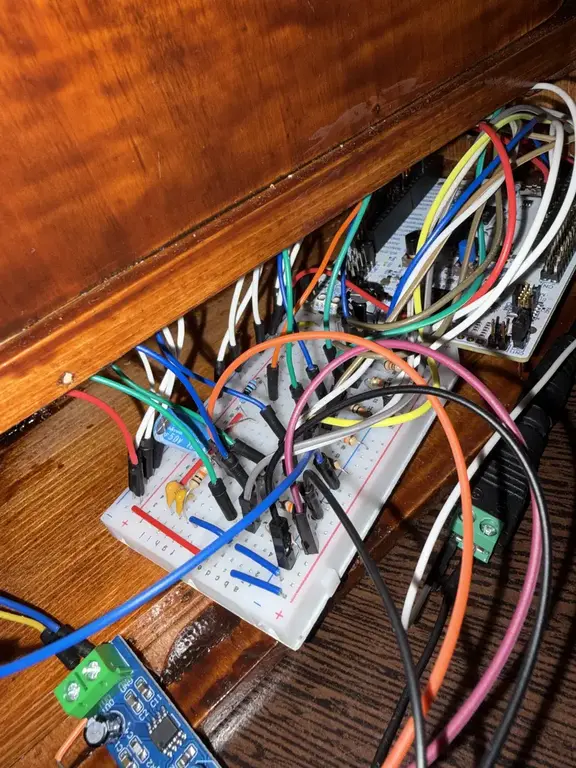
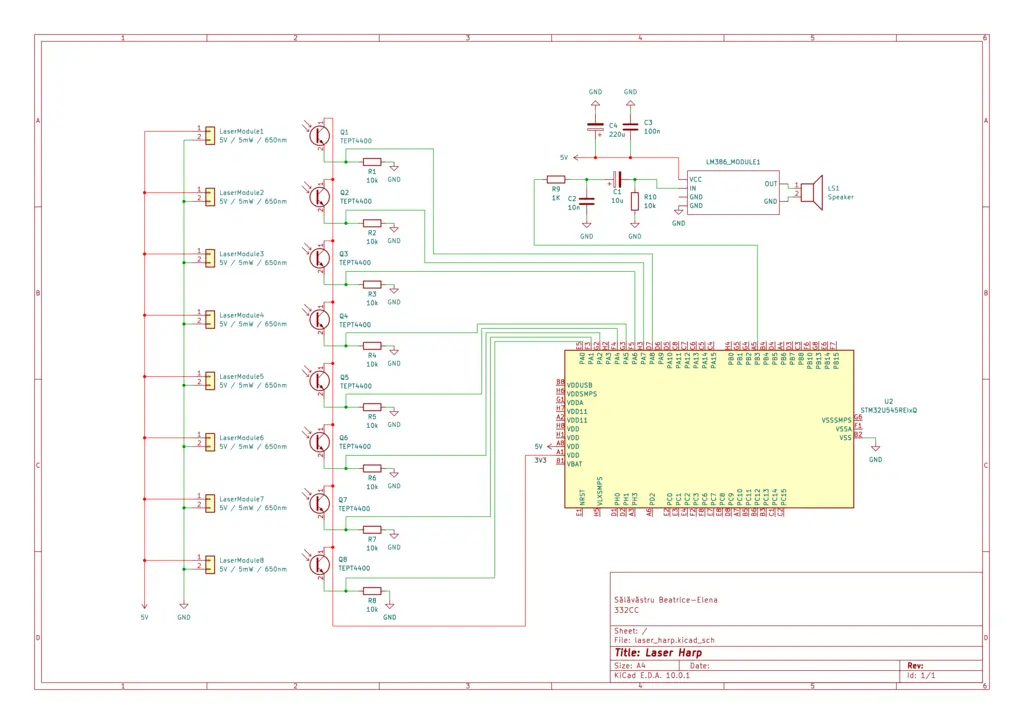
The physical harp uses 8 laser modules, each aligned with a phototransistor. The phototransistors are connected to GPIO pins configured as external interrupt inputs. When a laser beam is interrupted, the corresponding input changes state and the STM32 detects the event as a string trigger.
For audio output, the STM32 generates a high-frequency PWM signal on PB3 / TIM2_CH2. This signal is passed through a simple analog filtering stage and then sent to an LM386 audio amplifier, which drives an 8Ω speaker.
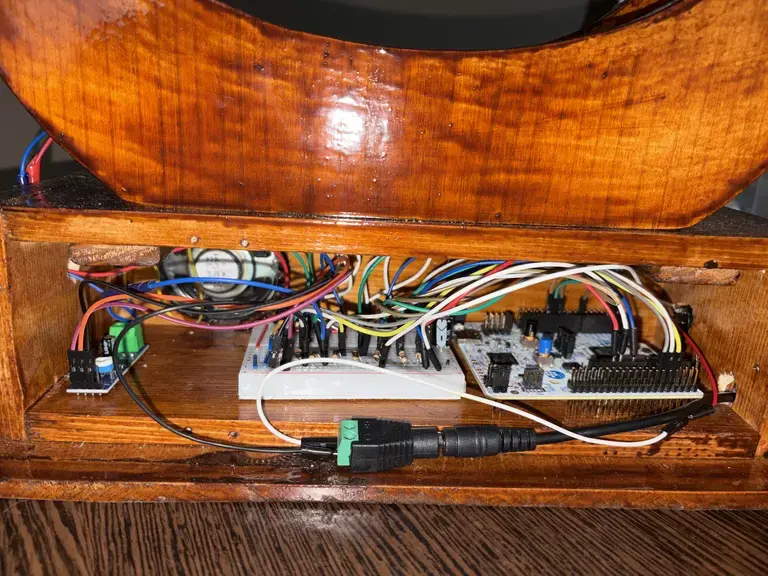
The structure is mounted on a custom wooden frame that keeps the lasers and sensors aligned.
Hardware Photos
Schematics
Bill of Materials
| Device | Usage | Price |
|---|---|---|
| Nucleo U545RE | Microcontroller | ~120 RON |
| Laser modules x10 | Light beams (strings) | 20 RON total |
| TEPT4400 x11 | Light detection | 16.76 RON total |
| LM386 module | Audio amplification | 4.14 RON |
| Speaker (8Ω) | Sound output | 23.02 RON |
| Resistors 10kΩ | Signal conditioning | 10.38 RON |
| Capacitors 100µF | Power filtering | 4.07 RON |
| Capacitors 100nF | Noise filtering | 6.47 RON |
| Capacitors 0.1µF | Decoupling | 8.16 RON |
| Rocker switch | Power ON/OFF | 4.43 RON |
| Power supply 5V 2A | Power source | 22.61 RON |
| DC jack connector | Power connection | 3 RON |
Software
| Library | Description | Usage |
|---|---|---|
| embassy-stm32 | STM32 HAL for Embassy | Used for GPIO/EXTI input handling, PWM audio output, timer configuration and clock setup |
| embassy-executor | Async task executor | Runs the main application and the separate laser string monitoring tasks |
| embassy-time | Timekeeping and delays | Used for sensor cooldowns and precise audio sample timing |
| embassy-sync | Synchronization primitives | Provides the channel used to send triggered note indices from sensor tasks to the audio loop |
| defmt | Lightweight logging framework | Used for debug and status messages |
| defmt-rtt | RTT logging transport | Sends debug logs from the board to the PC |
| panic-probe | Panic handler | Reports crashes through the debug probe |