GPS Fitness Tracker
A fitness tracking device that monitors physical activity by counting steps and recording GPS-based workouts, providing real-time statistics and storing workout data.
Author: Maraloi Ioana
GitHub Project Link: https://github.com/UPB-PMRust-Students/acs-project-2026-Ioana-Maraloi
Description
This project implements a fitness tracking device using a microcontroller programmed in Rust. The system operates in two modes. In daily mode, it detects steps using accelerometer data, estimates distance and calories, and displays real-time information on a screen. In training mode, activated via a button, it uses GPS data to track position, compute distance and speed, and record the route. The recorded data is saved in GPX format for later analysis.
Motivation
I chose this project because it combines several important aspects of embedded systems, including sensor data processing, GPS-based measurements, and real-time data display. It provides a good balance between hardware interaction and software implementation, while also covering topics such as data acquisition, processing, and storage in a practical context.
Architecture
The system is centered around a processing module running on the STM32 microcontroller. It receives data from the sensor, GPS, and control modules, processes it, then sends the results to the display and storage modules.
Main architecture components:
- Control Module – handles button input and mode switching
- Sensor Module – provides motion data for step detection
- GPS Module – provides position, speed, and time data
- Processing Module – computes steps, distance, speed, calories, and workout state
- Display Module – shows real-time activity information
- Storage Module – saves workout data for later analysis

Log
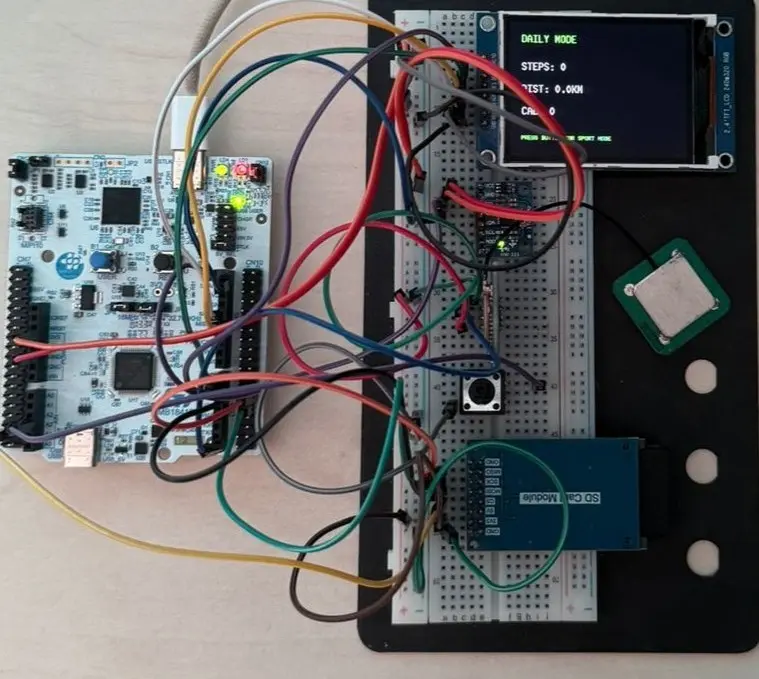
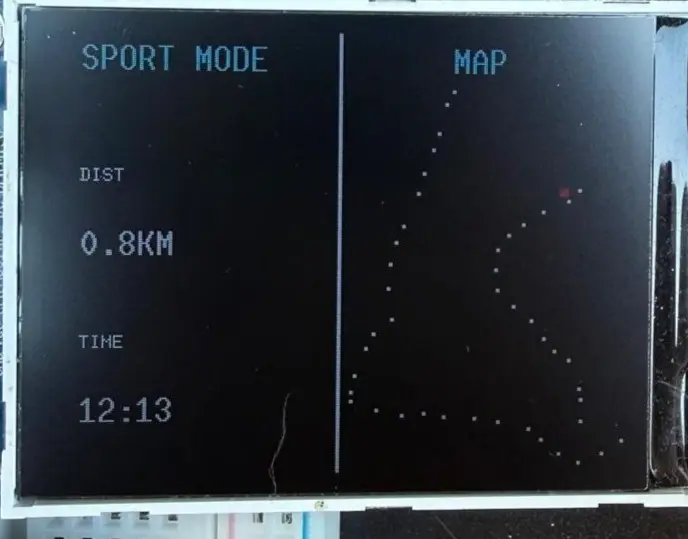
Week 5 - 11 May
Ordered hardware components and finished documentation.
Week 12 - 18 May
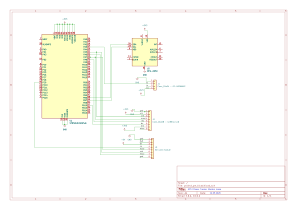
Finished hardware assembly and created the KiCad schematic. Successfully tested LCD display output, GPS communication and verified MPU6050 sensor.
Week 19 - 25 May
Created multiple operating states: daily mode, sport mode, and a confirmation state for saving workouts. Finished software implementation. Integrated SD card support for persistent workout storage(GPX format). Tested gps by walking around campus.
Hardware
The system is built around an STM32 Nucleo development board, which interfaces with multiple peripherals for sensing, display, and storage.
An MPU6050 accelerometer module is used to detect motion and enable step counting. A NEO-6M GPS module provides location data for tracking distance, speed, and route information.
A 2.4" display is used to present real-time data to the user, including activity statistics and system status. User input is handled through push buttons, allowing mode switching and interaction.
Workout data is stored using a microSD card module, enabling later analysis. Additional components such as LEDs are used for status indication, while a breadboard, jumper wires, and resistors are used for prototyping and circuit connections.
Schematics
Bill of Materials
| Device | Usage | Price |
|---|---|---|
| STM32 Nucleo-U545RE-Q | The microcontroller | provided by university |
| ILI9341 2.4 inch display | display for user interface and real-time data visualization | 80 RON |
| MPU6050 GY-521 accelerometer module | Measures motion and is used for step detection | 32 RON |
| MicroSD Card Module | Reads and writes data to the microSD card for storing workout logs | 19 RON |
| GPS Module NEO6MV2 | Provides location data for tracking distance, speed, and route | 30 RON |
| microSD Card 8GB | Stores workout data and GPS logs | 40 RON |
| Push button | User input for mode switching and interaction | 5 RON |
| Breadboard + Jumper Wires | prototyping and connecting components | 30 RON |
| SD card reader with usb adaptor | read data from sd card | 36 RON |
Software
| Library | Description | Usage |
|---|---|---|
| embassy-rs | Async embedded framework for Rust | Task scheduling and async execution |
| embassy-stm32 | STM32 HAL for embassy | UART, SPI, I2C, GPIO peripheral communication |
| defmt | Embedded logging framework | Debug messages in terminal |
| embedded-graphics | 2D graphics library | Drawing text and interface elements on LCD |
| embedded_sdmmc | SD library | Used for writing gpx data on SD card |