Game Controller
A custom wired game controller inspired by Xbox/PlayStation designs, built on STM32 Nucleo-U545RE-Q, connected to the host via USB-C.
Author: Țopa Mihai-Sebastian
GitHub Project Link: https://github.com/UPB-PMRust-Students/acs-project-2026-topa-mihai-sebastian
Description
This project is a wired game controller that connects to a computer via USB-C, presenting itself as a standard HID (Human Interface Device) — natively recognized by any modern operating system, no extra drivers needed.
The controller features:
- 2 analog joysticks (left/right), each with a clickable button (L3/R3)
- 2 analog triggers (L2/R2), each with its own linear potentiometer
- 4 face buttons (A, B, X, Y)
- D-Pad (4 directions)
- Shoulder buttons (L1, R1)
- System buttons (Start, Select, Home)
- Vibration motor for haptic feedback, PWM-controlled
- USB-C powered — no batteries needed
I initially planned a two-microcontroller architecture (STM32 + ESP32-C3) communicating over Bluetooth LE, but decided against it — coordinating BLE HID between two microcontrollers turned out to be quite complex. The final design uses a single STM32 Nucleo-U545RE-Q that reads all inputs and connects directly to the host as a USB HID gamepad.
Motivation
As an avid gamer, I wanted to understand how a controller works from the ground up — from analog signal acquisition to OS-level communication. This project lets me work with ADC, GPIO, PWM, and USB HID all in one practical device.
Architecture
┌─────────────────────────────────────────────────────────────┐
│                        INPUT LAYER                          │
│  [Joystick L] [Joystick R] [Trigger L] [Trigger R]          │
│  [Buttons x18]             [Vibration Motor]                │
└───────────────────────┬─────────────────────────────────────┘
                        │ ADC / GPIO / PWM
                        ▼
┌─────────────────────────────────────────────────────────────┐
│               STM32 Nucleo-U545RE-Q                         │
│  - Reads ADC: 4 joystick axes + 2 triggers                  │
│  - Reads GPIO: 18 buttons                                   │
│  - Controls vibration motor via PWM                         │
│  - Acts as USB HID Gamepad                                  │
└───────────────────────┬─────────────────────────────────────┘
                        │ USB-C
                        ▼
                  [ PC / Laptop ]
Log
Week 1
- Defined the architecture and component list.
- Researched the USB HID protocol for gamepads.
Week 2
- Wired the joysticks and verified ADC readings on all 4 axes.
- Wired all buttons and verified GPIO readings.
Week 3
- Implemented USB HID on the STM32 using the Embassy USB stack.
- Tested controller recognition by the operating system.
Week 4
- Wired the potentiometers for the analog triggers.
- Wired the vibration motor and tested PWM control.
- Full integration test.
Hardware
Main Components
1. STM32 Nucleo-U545RE-Q
The only microcontroller in the project. Reads all inputs, controls the vibration motor, and communicates with the host via USB HID.
- 6 ADC channels: Joystick L (X, Y), Joystick R (X, Y), Trigger L, Trigger R
- 18 GPIO pins for buttons
- 1 PWM output for the vibration motor
- USB Full Speed via USB-C (CN3) to the host
- Powered via USB-C; provides 3.3V on Morpho pins (CN7) for peripherals
2. Analog Joysticks PS2 Module (×2)
Standard XY joystick modules with integrated push-button (L3/R3). Each module: VCC, GND, VRx, VRy, SW.
- VRx/VRy → 2 ADC channels per joystick
- SW → GPIO with internal pull-up
3. Tactile Buttons 12×12mm (×20)
A, B, X, Y, L1, R1, Start, Select, Home, D-Pad ×4, L3, R3 + 2 spare.
- Wired between GPIO and GND, internal pull-up enabled in firmware
4. Analog Triggers — Linear Potentiometers 10K (×2)
One potentiometer per trigger (L2 and R2).
- Wiper → ADC channel on STM32
- 0–3.3V range mapped to the trigger axis value
5. Vibration Motor (PWM, DC, 3–5V)
ERM coin-type motor, driven by an NPN transistor (S8050 or BC337) and a flyback diode (1N4148).
STM32 GPIO (PWM) → Transistor base → Motor → 3.3V
                                     1N4148 in parallel with motor
6. Power Supply
The board is powered via USB-C (5V from the USB bus). The Nucleo's onboard regulator provides 3.3V on the Morpho pins (CN7) for all peripherals. No external regulator is needed.
Schematics

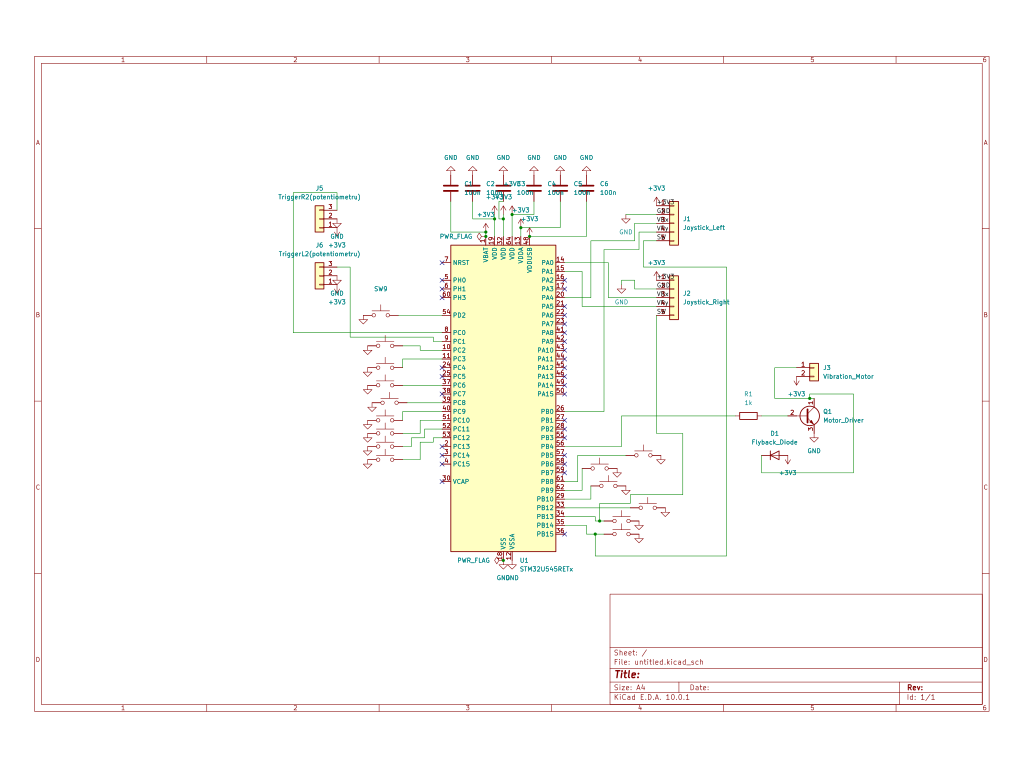
The schematic covers the following connections:
Joysticks (×2)
| Signal | STM32 Pin |
|---|---|
| Joystick L — VRx | ADC channel (TBD) |
| Joystick L — VRy | ADC channel (TBD) |
| Joystick L — SW | GPIO (TBD) |
| Joystick R — VRx | ADC channel (TBD) |
| Joystick R — VRy | ADC channel (TBD) |
| Joystick R — SW | GPIO (TBD) |
Triggers (×2)
| Signal | STM32 Pin |
|---|---|
| Trigger L — wiper | ADC channel (TBD) |
| Trigger R — wiper | ADC channel (TBD) |
Buttons (×18)
| Button | STM32 Pin |
|---|---|
| A, B, X, Y | GPIO (TBD) |
| L1, R1 | GPIO (TBD) |
| Start, Select, Home | GPIO (TBD) |
| D-Pad ×4 | GPIO (TBD) |
| L3, R3 | GPIO (TBD) |
Vibration Motor
| Signal | STM32 Pin |
|---|---|
| PWM control | TIM channel (TBD) |
Bill of Materials
| Device | Usage | Price |
|---|---|---|
| STM32 Nucleo-U545RE-Q | Main microcontroller + USB HID | ~110 RON (owned) |
| Joystick Module 2-Axis XY ×2 | Left + right joystick with L3/R3 | 5.45 RON × 2 |
| Tactile Button PCB 12×12×7.3mm ×20 | A, B, X, Y, D-Pad, L1, R1, Start, Select, Home | 1.33 RON × 20 |
| Linear Potentiometer Module 10K ×2 | Analog triggers L2 and R2 | 12.52 RON × 2 |
| Vibration Motor Module DC PWM 3–5V | Haptic feedback | 5.36 RON |
| Breadboard 400p ×3 | Prototyping base | 6.62 RON × 3 |
| Dupont Wire 30cm M-M ×2 (40pcs/set) | Breadboard connections | 8.39 RON × 2 |
| Dupont Wire 30cm M-F ×1 (40pcs/set) | Module connections | 7.59 RON |
| Ceramic Capacitor Set 300pcs | VCC / ADC decoupling | 12.55 RON |
| Resistor Kit 30 values 600pcs | Pull-up / protection | 15.16 RON |
| Subtotal (components) | 139.84 RON | |
| Delivery | 15.15 RON | |
| Total (cart incl. VAT) | 154.99 RON | |
| Grand Total (incl. Nucleo) | ~265 RON |
Software
(To be developed)
Firmware will be written in Rust using the Embassy async framework for STM32. Implementation details will be added as development progresses.