VERIT-SCAN
A multi-sensor fresh fruit quality analyzer with data fusion from 4 physical domains
Author: Costache David
GitHub Project Link: Github
Description
VERIT-SCAN is a non-destructive fresh fruit quality analyzer that fuses measurements from four independent physical domains — aroma (VOC + humidity), firmness (elastic deformation under controlled force), apparent density (mass / laser-estimated volume), and electrical conductivity — into a single Overall Quality Score. The results are displayed locally on an OLED screen with RGB LED feedback and streamed via UART to a host PC for logging and plotting.
Motivation
Fruit quality assessment is traditionally subjective: we squeeze, sniff, and judge by appearance. These signals are real but hard to quantify, compare across samples, or log over time. VERIT-SCAN replaces subjective judgment with four quantifiable measurements drawn from distinct physical domains — chemistry (VOCs), mechanics (elasticity), geometry + mass (density), and electrochemistry (ionic conductivity). The project is an exercise in multi-sensor data fusion: no single sensor tells the whole story, but together they build a meaningful quality score. It also explores a non-destructive approach to firmness testing, replacing the traditional penetrometer (which damages the sample) with an elastic-deformation measurement that leaves the fruit intact.
Architecture
The system is structured around an async embedded runtime (Embassy on STM32U545) with the following architectural components:
- Sensor Acquisition Layer — four concurrent async tasks, one per measurement channel:
- Aroma Task — reads BME680 over I²C every 500 ms (VOC resistance + humidity)
- Firmness Task — orchestrates the VL53L0X + HX711 interaction (baseline distance → force ramp → final distance)
- Density Task — combines HX711 weight reading with VL53L0X height estimation
- Conductivity Task — samples the internal ADC (14-bit) on the electrode divider
- Fusion & Scoring Layer — a coordinator task that collects readings from the four acquisition tasks via Embassy channels, normalizes each raw value to a 0–100 score based on calibrated per-fruit-type thresholds, and computes the weighted Overall Quality Score.
- Presentation Layer — three parallel output tasks:
- Display Task — renders scores on the SSD1306 OLED using embedded-graphics
- Indicator Task — drives the RGB LED via PWM (green/yellow/red mapping) and the buzzer at measurement completion
- Telemetry Task — streams a JSON line per measurement on UART2 (exposed as ST-Link Virtual COM Port) to the host PC
- Host-side Plotting — a Python script (pyserial + matplotlib) running on the PC parses the JSON stream and plots all four scores + the overall score in real time.
Data flow: Sensors → Acquisition Tasks → (Embassy Channel) → Fusion Task → (Embassy Channel) → Display / Indicator / Telemetry Tasks.
(Graphical block diagram to be added.)
Architecture Diagram

Log
Week 5 - 11 May
I have assembled the hardware components on a breadboard and started prototyping the software architecture. Unfortunattely, the sensors weren't soldered properly, which caused a delay and force me to redo the wiring.
Week 12 - 18 May
I have securely mounted the hardware components onto their dedicated support structure, ensuring a clean, organized, and nice layout. The setup now features proper cable management and perfectly aligned sensors, giving the physical prototype a polished, final look. With the hardware architecture completely stabilized and visually refined, my focus has now shifted to the software development phase. I am currently writing and testing the firmware.
Week 19 - 25 May
During this final week, I focused on system stabilization and achieving a polished, professional finish for the prototype. I completed the core firmware integration, ensuring reliable data acquisition from all sensors (HX711, BME680, and ADC). Successfully integrated the buzzer and RGB LED logic, creating a clear feedback system for fruit quality assessment.
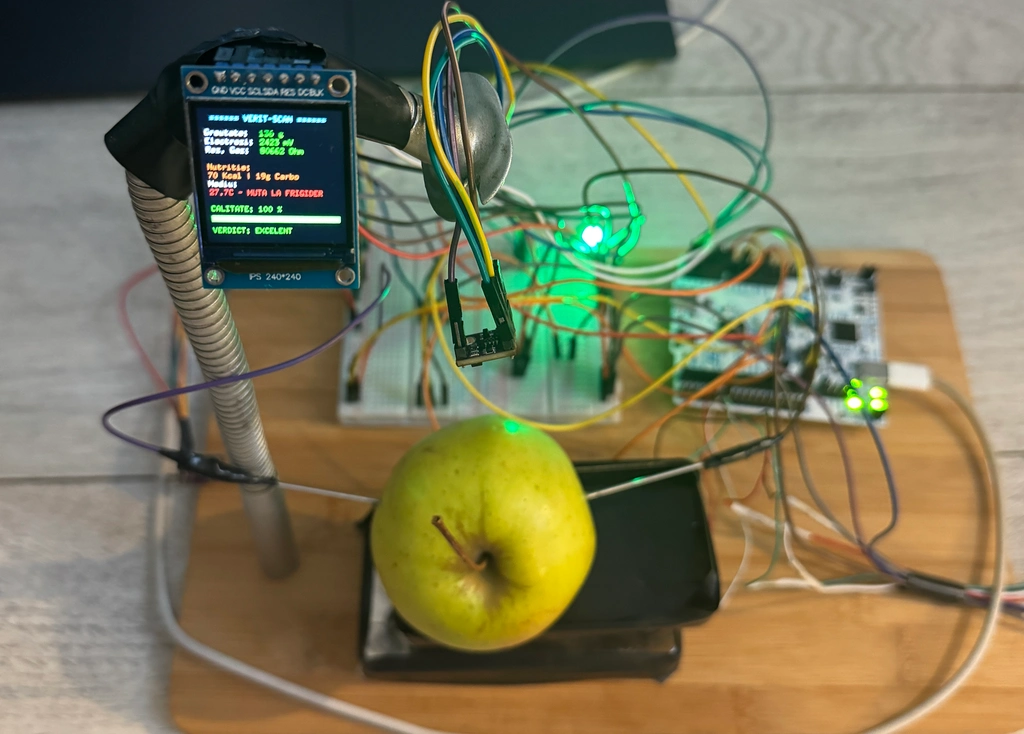
Hardware
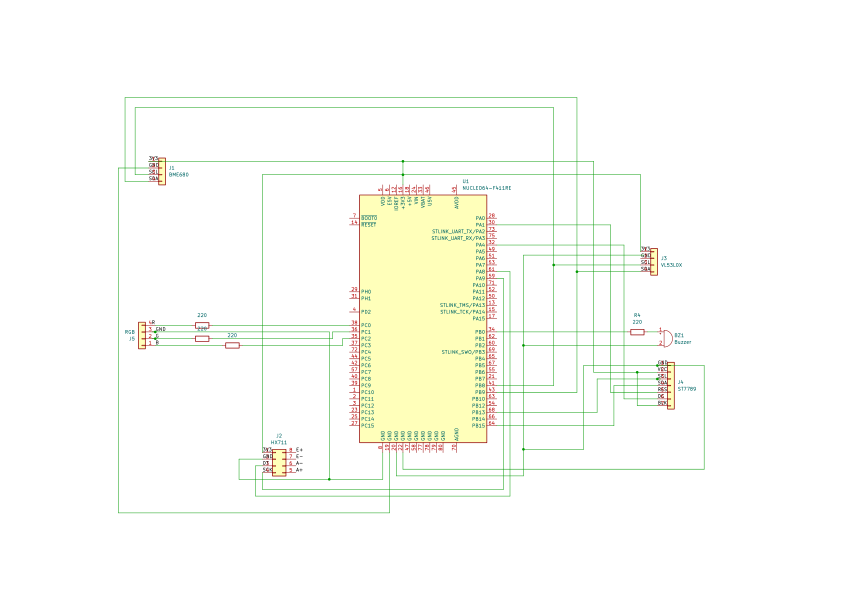
The core of VERIT-SCAN is a NUCLEO-U545RE-Q board, built around the STM32U545RE (ARM Cortex-M33, 160 MHz, 512 KB flash, 272 KB SRAM) with an integrated ST-Link V3 debugger. The board exposes four I²C buses, two UARTs, a 12-bit ADC, and a 14-bit ADC — the latter is used for the DIY conductivity channel, where two stainless-steel electrodes in contact with the fruit flesh form a voltage divider with a 10 kΩ precision reference resistor.
Three digital sensors share a single I²C bus: BME680 (VOC + humidity + temperature + pressure), VL53L0X (time-of-flight laser distance, used both for firmness-via-deformation and for height/volume estimation), and an SSD1306 0.96" OLED for local display. An HX711 24-bit ADC interfaces the 1 kg load cell, which is used both for weighing and for monitoring the controlled force applied during the non-destructive firmness test. User feedback comes from a common-cathode RGB LED driven by three PWM channels and a passive buzzer driven by a timer PWM. Communication with the host PC uses USART2, exposed transparently as a Virtual COM Port through the on-board ST-Link, so no external USB-to-UART adapter is needed.
Schematics
Bill of Materials
| Device | Usage | Price |
|---|---|---|
| NUCLEO-U545RE-Q | Main MCU board (STM32U545RE, Cortex-M33 @ 160 MHz, ST-Link V3 onboard) | already owned |
| BME680 I²C Module | Aroma measurement (VOC + humidity + temperature + pressure) | 82.62 RON |
| VL53L0X ToF Module | Laser distance sensor — baseline + deformation measurement, height/volume estimation | 17.04 RON |
| Load Cell 1 kg | Weight + controlled-force measurement during firmness test | 12.80 RON |
| HX711 24-bit ADC | Load cell amplifier and ADC | 4.57 RON |
| SSD1306 OLED 0.96" I²C | Local display of per-channel and overall scores | 16.96 RON |
| RGB LED 5 mm common cathode | Quality indicator (green / yellow / red via PWM) | 1.51 RON × 3 |
| Passive buzzer 5 V | Audible signal at measurement completion | 1.45 RON |
| 2× Stainless steel screws M3/M4 | DIY conductivity electrodes | ~2 RON |
| Resistor 10 kΩ 1% metal film | Voltage divider reference for conductivity ADC channel | 3.20 RON / 20 pcs |
| Resistor 220 Ω 1% metal film | Current limiting for RGB LED | 3.20 RON / 20 pcs |
| Breadboard 400 points | Prototyping | 6.62 RON × 2 |
| Dupont wires 30 cm M-M and M-F | Interconnects | ~16 RON |
Software
| Library | Description | Usage |
|---|---|---|
| embassy-stm32 | Async HAL for STM32 (feature stm32u545re) | Core hardware abstraction: GPIO, I²C, ADC, UART, PWM, async timers |
| embassy-executor | Async task executor for no_std environments | Concurrent sensor acquisition and output tasks |
| embassy-time | Async time primitives | Timing for sampling periods and force ramps |
| embassy-sync | Sync primitives (channels, mutexes) | Inter-task communication between acquisition and fusion layers |
| ssd1306 | Driver for SSD1306 OLED displays | OLED rendering over I²C |
| embedded-graphics | 2D graphics primitives | Drawing score bars, text, and icons on the OLED |
| bme680 | BME680 sensor driver | Reading VOC resistance + humidity |
| vl53l0x | VL53L0X ToF sensor driver | Distance / deformation / height measurement |
| loadcell | HX711 driver for load cells | Reading force and weight from the 1 kg load cell |
| defmt + defmt-rtt | Efficient logging framework | Debug output over RTT during development |
| probe-rs | Embedded flashing and debugging | Flashing firmware to NUCLEO-U545RE-Q via ST-Link V3 |
| heapless | Fixed-capacity collections for no_std | Score buffers and telemetry line buffering |
| serde + serde-json-core | no_std JSON serialization | Formatting telemetry lines sent over UART |
| pyserial + matplotlib (host-side Python) | Host-side serial reader and live plotter | Parsing JSON telemetry from UART and plotting the 4 scores + overall in real time |
Links
- NUCLEO-U545RE-Q Product Page
- STM32U545RE Datasheet
- STM32U545 Reference Manual (RM0456)
- BME680 Datasheet — Bosch Sensortec
- VL53L0X Datasheet — STMicroelectronics
- HX711 Datasheet — AVIA Semiconductor
- SSD1306 Datasheet
- The Embassy Book
- Rust Workshop UPB — Embassy on STM32U545
- embassy-stm32 on crates.io