Mini Solar System Simulator
A model depicting the Earth's rotation and revolution movements around the Sun, surrounded by constellations
Author: Daria-Antonia Niculescu
GitHub Project Link: https://github.com/UPB-PMRust-Students/acs-project-2026-ifrit18
Description
This project is a mechanical and electronic simulation of orbital motion, designed as an interactive educational tool. The device uses an STM32 development board to control the rotation of a mechanical arm (representing Earth's orbit) around a light center (the Sun). The project provides real-time information on an OLED screen and envisions constellations through LED light points.
Motivation
I chose this project because it allows me to bring together two of my biggest passions: astronomy and hardware. It presents a unique challenge to bridge the gap between abstract celestial mechanics and tangible physical implementation and also give me the opportunity to present a visually stunning scenary.
Architecture
The project is divided into a few main parts that work together.
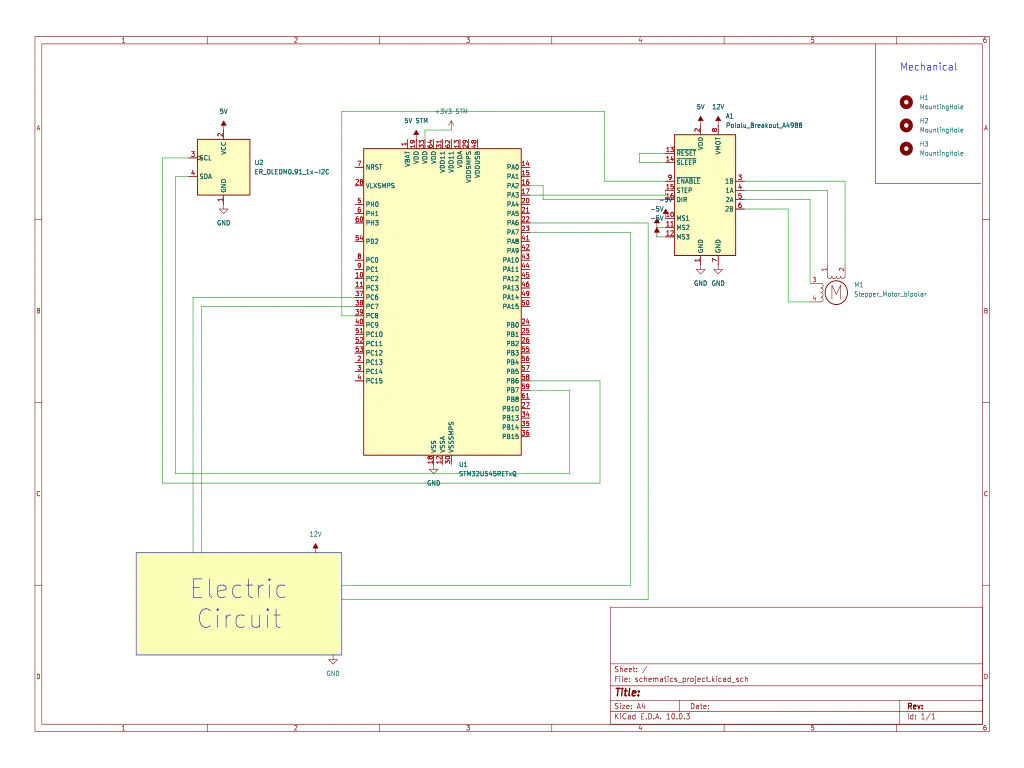
TM32 Control Unit: The brain that processes encoder inputs, manages orbital timing, and controls the OLED and motor driver.
Precision Drive System: A NEMA 17 motor with an A4988 driver provides micro-stepping for smooth revolution, using a flexible coupling to dampen vibrations.
Visual Interface (HMI): A 0.96" OLED displays real-time telemetry, while a rotary encoder allows for intuitive speed and menu adjustments.
Celestial Lighting: A central WS2812B RGB Ring represents the Sun, complemented by a 16-LED matrix to illuminate specific star patterns.
Power Management: A 12V supply powers the motor, while an LM2596 Step-Down converter provides stable 5V logic power for the STM32 and LEDs.
Rapid-Prototyping Framework: Uses an MB-102 Breadboard and Kapton tape for a screwless, modular assembly that is easy to modify and repair.

Gallery
Step 1
Step 2
Step 3
Step 4
Step 5
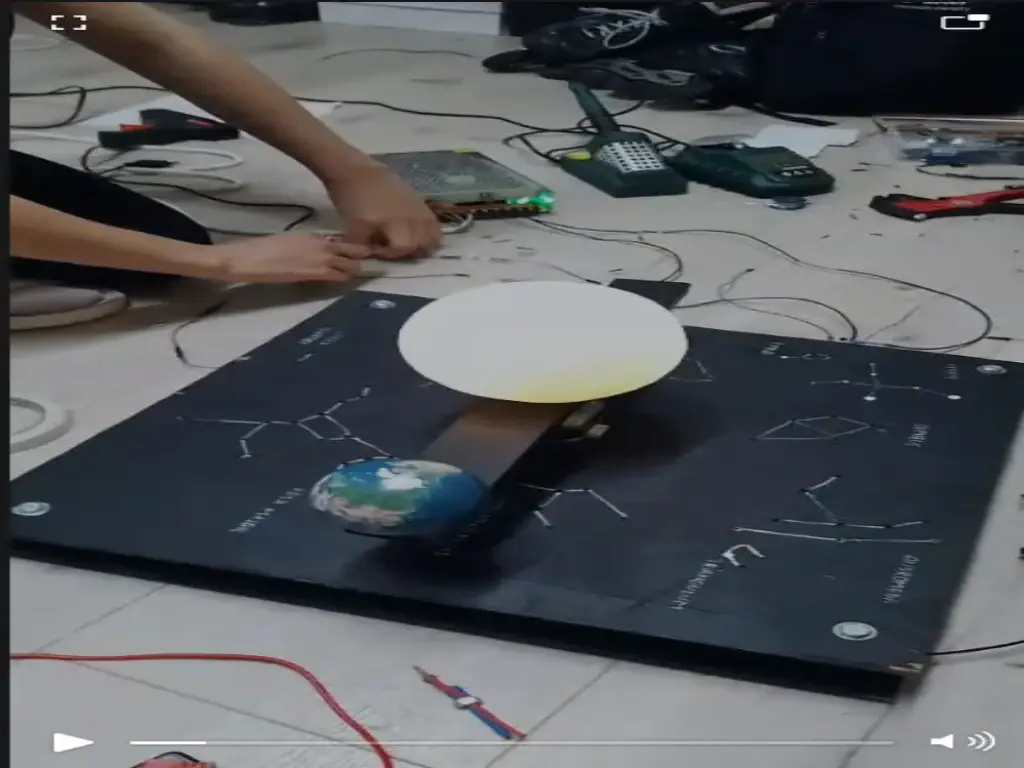
Video Demonstration
Log
Week 20 - 24 April
Ordered the hardware components.
Week 27 - 30 April
Picked up the hardware components and started the documentation process.
Week 4 - 10 May
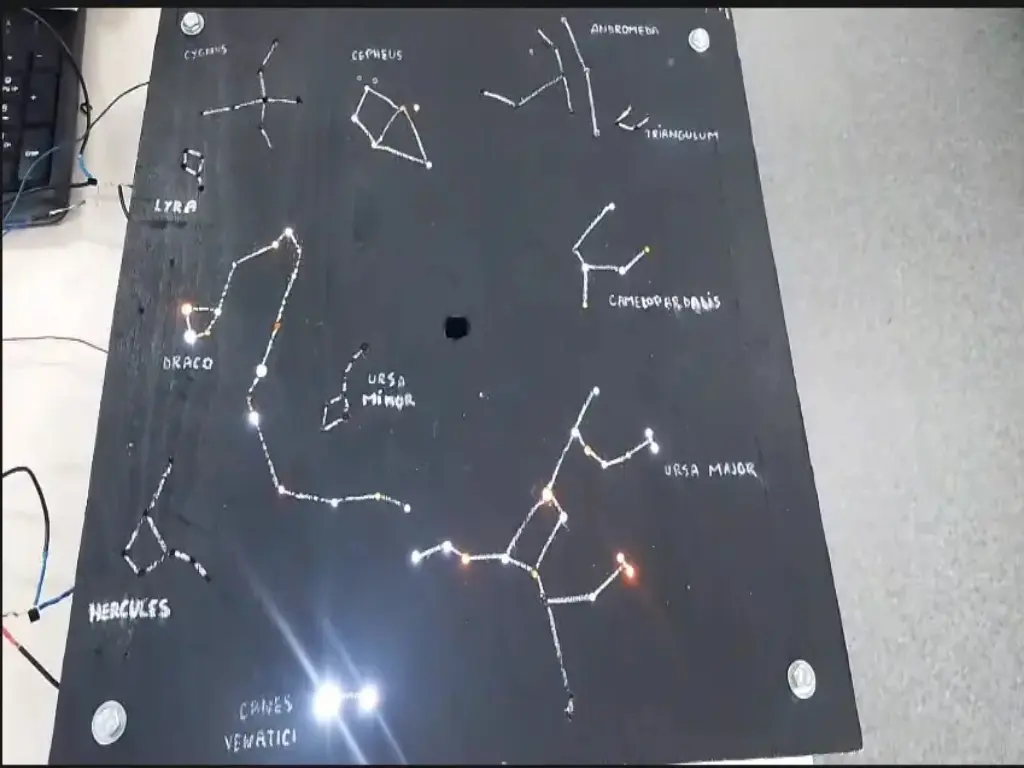
Created the constellation design. Cut up the model for the sky and made the holes for the stars. Also connected the NEMA Motor to the driver.
Week 11 - 17 May
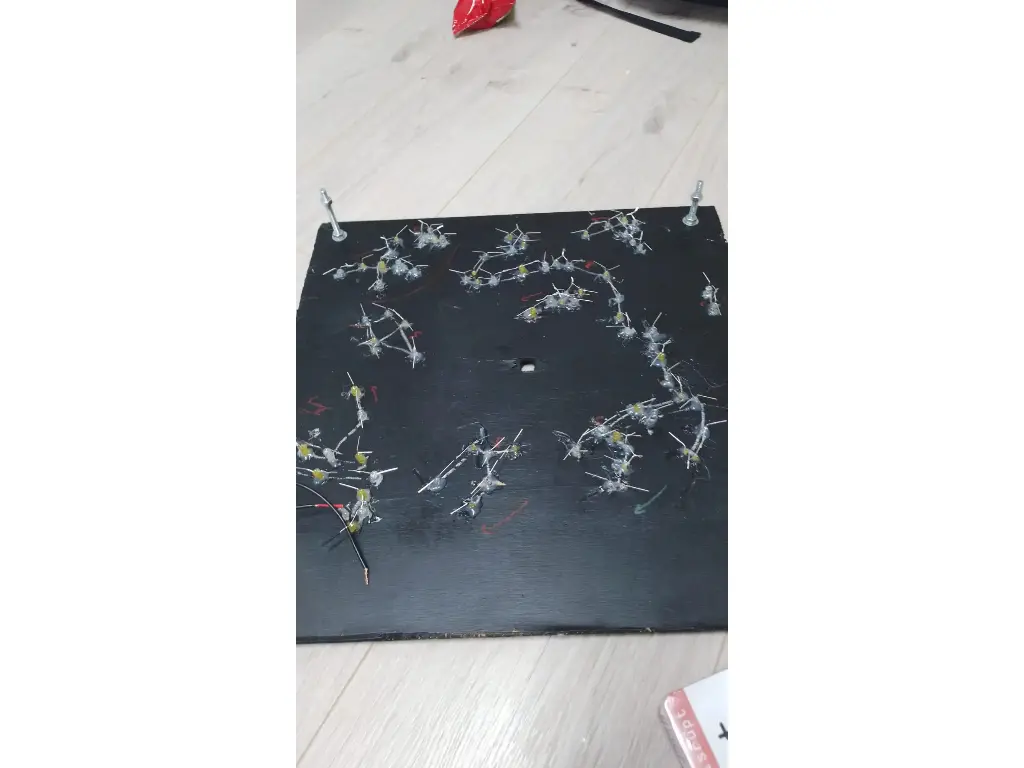
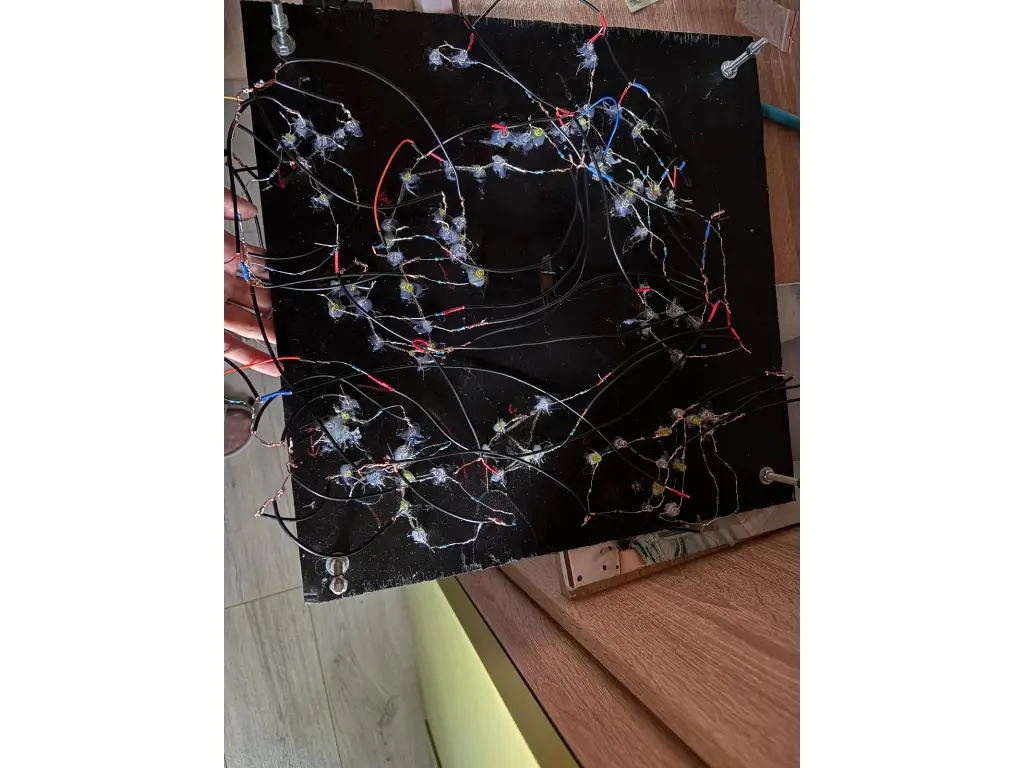
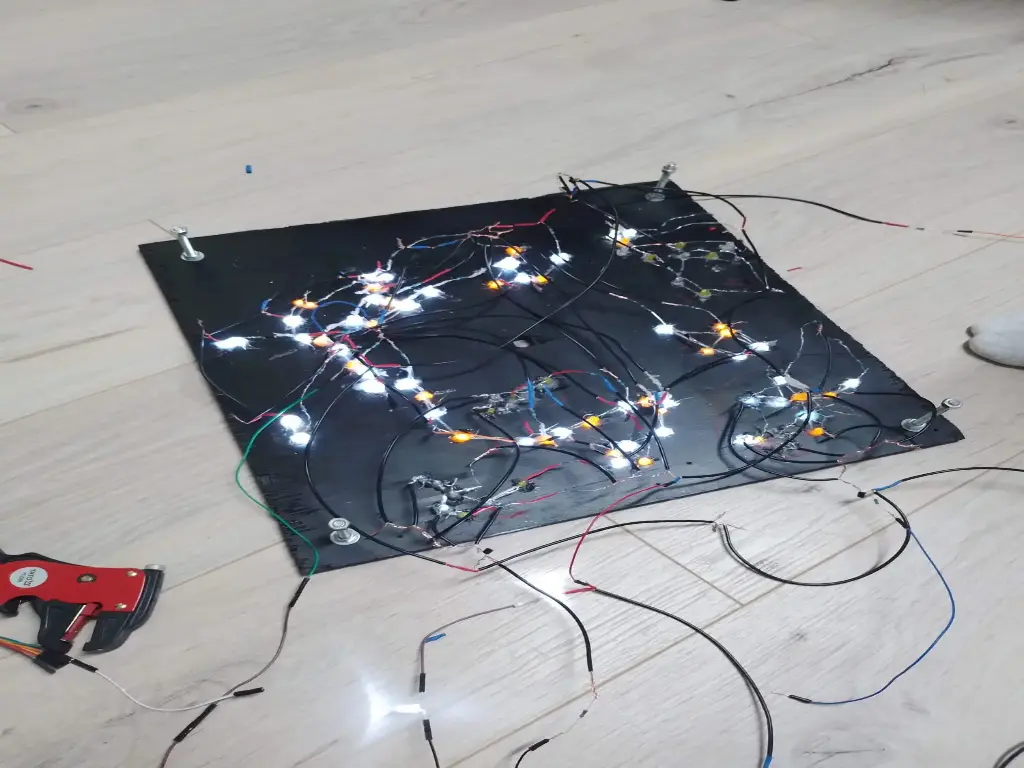
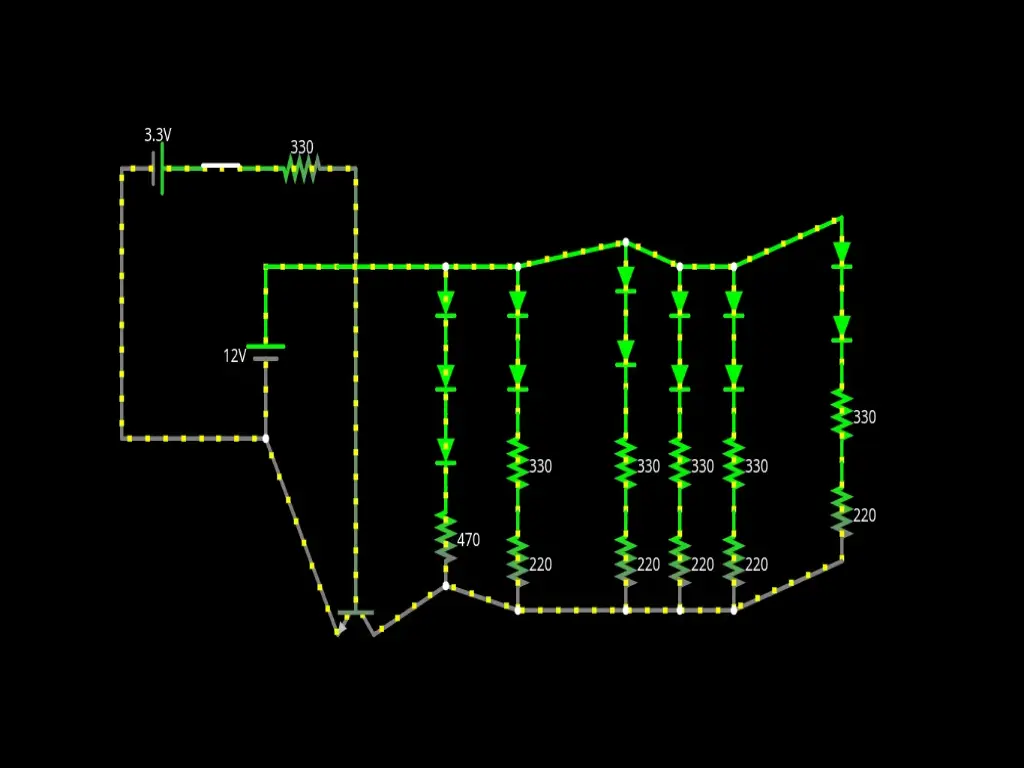
Started working on the electric circuit and sticking the 92 LEDs into the right position. Grouped the LEDs into 2 groups controlled by four pins. As I was makeing them, I was testing them one by one. On Sunday night, I short-circuited the microcontroller.
Week 18 - 24 May
Got a new microcontroller, then I started redoing the circuit and better isolating the wires. On Tuesday, it worked!! Added the OLED screen, the motor and started the software part, which was the easiest.
Week 25 - 27 May
Completed the documentation.
Hardware
Fastening: Structural screws were eliminated in favor of hot gun glue for securing modules onto the aluminum arm, ensuring a lightweight and non-conductive mounting solution.
Constellations: The star map is implemented via a manually perforated wood panel, with rear-mounted LEDs aligned to the apertures to create a precise point-source light effect.
Bill of Materials
| Device | Usage | Price |
|---|---|---|
| STM32 Blue Pill | Central Processing Unit | free |
| Motor NEMA 17 | Stepper motor for the orbital motion of the arm | ~70 lei |
| Driver A4988 | Current and step control for the motor | ~ 8 lei |
| OLED 0.96" I2C | Real-time telemetry display and menu | ~ 18 lei |
| Encoder Rotativ | User input device (speed, navigation) | ~ 4 lei |
| Plastic Sun | Visual representation of the Sun | ~ 15 lei |
| Sursă 12V 20A | Main power supply for the entire system | ~ 65 lei |
| Cuplaj 5x8mm | Mechanical motor-shaft connection | ~ 10 lei |
| Glue gun | Insulating mechanical fastening | borrowed |
| LED-uri 5mm & 3mm | Point-source lighting for the constellation map | ~27 lei |
Schematics
Electric Circuit for one pin
Software
My program runs on an STM32 microcontroller using the Embassy async framework and spawns three concurrent tasks: a stepper motor driver that continuously pulses a STEP pin with precise microsecond timing, a LED sequencer that cycles through four constellation/season LED groups on a 2-second base timer, and a main loop that drives a 128×64 SSD1306 OLED display over I2C, rendering a simple calendar that cycles through the 12 Romanian month abbreviations every 2 seconds.
| Library | Description | Usage |
|---|---|---|
| embassy-stm32 | Async framework for embedded Rust | Peripheral drivers, I2C, GPIO |
| embassy-executor | Async task executor for embedded | Running 3 parallel async tasks |
| embassy-time | Time management in Embassy | Async timers and delays |
| ssd1306 | OLED display driver | Real-time data display via I2C |
| embedded-graphics | 2D graphics library for embedded | Text rendering on OLED |
| defmt | Lightweight logging framework | Debug output over RTT |
| panic-probe | Panic handler for embedded | Debugging and error reporting |